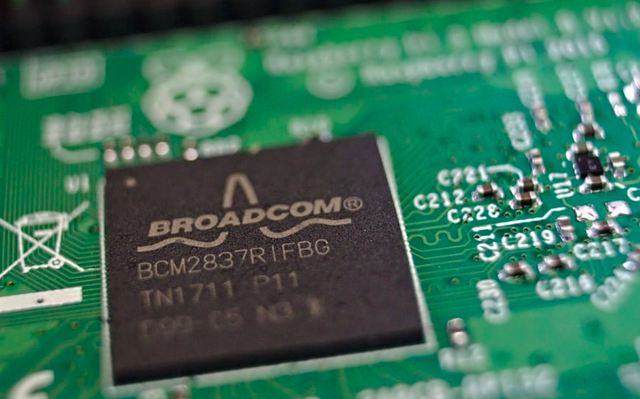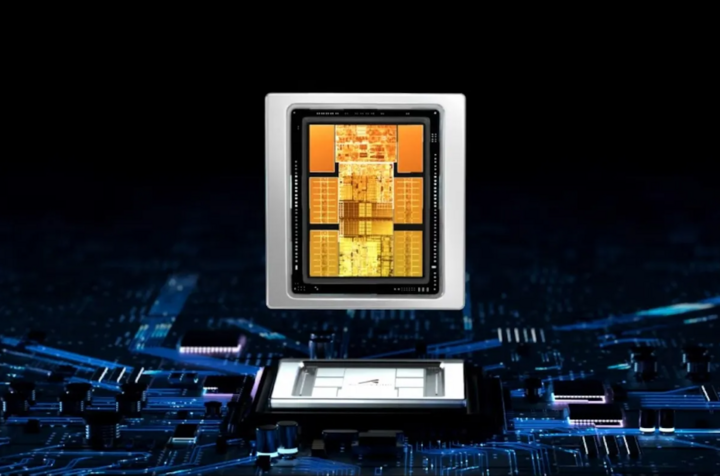


An AI Chip is a specialized processor designed and optimized to efficiently handle the massive parallel computations required for Artificial Intelligence workloads, particularly Machine Learning (ML) and Deep Learning (DL). Unlike general-purpose CPUs, these chips incorporate a diverse array of processing units tailored for speed and power efficiency in both model Training and Inference.
⚙️ The Evolution and Future of AI Chips
Artificial Intelligence (AI) is transforming industries at an unprecedented pace, and at the core of this revolution lies the AI chip. These specialized processors are designed to deliver faster computation, greater energy efficiency, and scalable intelligence — powering everything from massive model training in data centers to real-time inference at the edge.
Core Processing Units
AI workloads demand diverse hardware, each optimized for specific tasks:
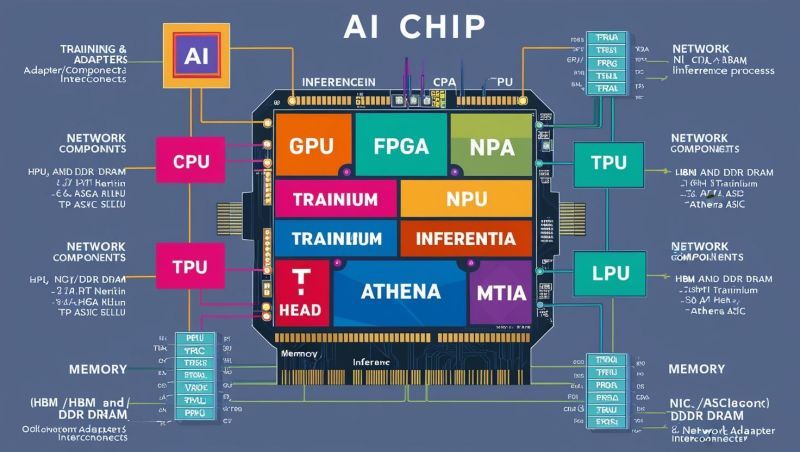
TPU (Tensor Processing Unit): Google’s flagship accelerator, engineered for matrix multiplications, the mathematical foundation of neural networks.
GPU (Graphics Processing Unit): Originally built for rendering graphics, GPUs now dominate AI training thanks to their massively parallel architecture.
NPU (Neural Processing Unit): Specialized circuits for deep learning and edge ML acceleration, balancing speed with efficiency.
CPU (Central Processing Unit): The general-purpose brain, handling operating systems, preprocessing, and non-ML workloads.
FPGA (Field-Programmable Gate Array): Reconfigurable hardware, adaptable to evolving AI algorithms post-manufacture.
LPU / MTIA / Athena ASIC: Proprietary, custom-designed accelerators for ultra-efficient execution of specific ML tasks.
T-Head: Conceptual/high-performance block, tailored for specialized computation or control.
Memory & Data Flow
Efficient AI computation depends not only on processors but also on memory and interconnects:
HBM (High Bandwidth Memory): 3D-stacked, ultra-fast memory placed close to processors — critical for training workloads.
DDR DRAM: High-capacity, general-purpose memory for system operations and dataset storage.
LPM / LATT: Low-power specialized memory for edge devices, balancing speed and efficiency.
Interconnects & Adapters: High-speed communication links ensuring seamless data flow between cores, memory, and networks.
Key Functions & Components
Beyond raw compute, AI chips rely on specialized components to orchestrate workloads:
AI Block: Master control unit coordinating data and instruction flow across heterogeneous cores.
Network Components: Hardware and logic enabling scaling across multiple chips or servers.
CPA / FPU (Floating-Point Units): Arrays of arithmetic units powering parallel floating-point math, essential for AI workloads.
Types of AI Chips
AI chips vary in design, flexibility, and specialization:
GPUs: Indispensable for training models, leveraging parallelism. Multiple GPUs can be connected for scalable performance.
FPGAs: Reprogrammable hardware with configurable logic blocks, ideal for custom AI solutions requiring flexibility.
NPUs: Purpose-built for deep learning and neural networks, optimized for inference tasks like image recognition and NLP.
ASICs: Custom-built for specific AI applications, delivering maximum performance but lacking reprogrammability.
Future of AI Chips
AI chips are not just enabling today’s breakthroughs — they are shaping the future of computing.
By Offerings
Processing Units: GPUs, CPUs, FPGAs, NPUs, TPUs, Trainium, Inferentia, T-Head, Athena ASIC, MTIA, LPUs.
Memory: High-speed DRAM (HBM, DDR) for efficient data handling.
Network Components: NICs, adapters, and interconnects for low-latency communication across distributed systems.
By Function
Training: Large-scale model development powered by parallel compute.
Inference: Real-time, low-power AI capabilities across cloud and edge.
Why It Matters
Market Value: Projected to reach $311.58 billion by 2029.
Key Players: NVIDIA, AMD, Intel, Micron, Google, Qualcomm, Apple, Huawei, SK Hynix, Samsung, Imagination Technologies, Graphcore, Cerebras.
The Next Wave
AI chips are evolving beyond silicon:
Neuromorphic architectures — mimicking the brain’s efficiency.
Quantum-inspired designs — unlocking new computational paradigms.
Domain-specific accelerators — maximizing performance for specialized AI tasks.
✨ Conclusion
From general-purpose CPUs to highly specialized ASICs, AI chips represent the backbone of modern intelligence. Their evolution — driven by innovation in processing units, memory, and interconnects — is setting the stage for a future where computation is faster, smarter, and more efficient. As industries embrace AI, these chips will continue to define the boundaries of what’s possible in technology.